Friday, March 28, 2025

652. Find Duplicate Subtrees --- M

Given the root of a binary tree, return all duplicate subtrees.

For each kind of duplicate subtrees, you only need to return the root node of any one of them.

Two trees are duplicate if they have the same structure with the same node values.


Example 1:

Input: root = [1,2,3,4,null,2,4,null,null,4]
Output: [[2,4],[4]]

Example 2:

Input: root = [2,1,1]
Output: [[1]]

Example 3:

Input: root = [2,2,2,3,null,3,null]
Output: [[2,3],[3]]


Constraints:

  • The number of the nodes in the tree will be in the range [1, 5000]
  • -200 <= Node.val <= 200

A:

错误的解法

/**
* Definition for a binary tree node.
* struct TreeNode {
* int val;
* TreeNode *left;
* TreeNode *right;
* TreeNode() : val(0), left(nullptr), right(nullptr) {}
* TreeNode(int x) : val(x), left(nullptr), right(nullptr) {}
* TreeNode(int x, TreeNode *left, TreeNode *right) : val(x), left(left), right(right) {}
* };
*/
class Solution {
public:
vector<TreeNode*> findDuplicateSubtrees(TreeNode* root) {
unordered_set<string> S;
unordered_map<string, TreeNode*> map;
helper(root, S, map);
vector<TreeNode*> res;
for(auto p : map){
res.push_back(p.second);
}
return res;
}
private:
string helper(TreeNode* root, unordered_set<string>& S, unordered_map<string, TreeNode*> &map){
if(!root)
return "";
auto l = helper(root->left, S, map);
auto r = helper(root->right,S, map);
auto node = l+"-"+to_string(root->val)+"-"+r;
if(S.find(node) != S.end()){
map[node] = root;
}else{
S.insert(node);
}
return node;
}
};

上述错误的原因是: 基于 inorder的表示方法。 string方法不唯一。
Given. [0,0,0,0,null,null,0,null,null,null,0]

上面的算法会算出: [[0,null,0],[0]]
而正确答案是 [[0]]


而正确的做法只需要改一行
auto node = "("+l+")"+to_string(root->val)+"("+r + ")";


Thursday, March 27, 2025

513. Find Bottom Left Tree Value (Medium)

Given the root of a binary tree, return the leftmost value in the last row of the tree.


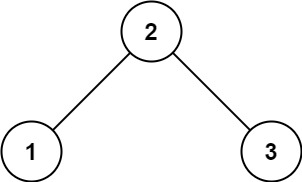
Example 1:

Input: root = [2,1,3]
Output: 1

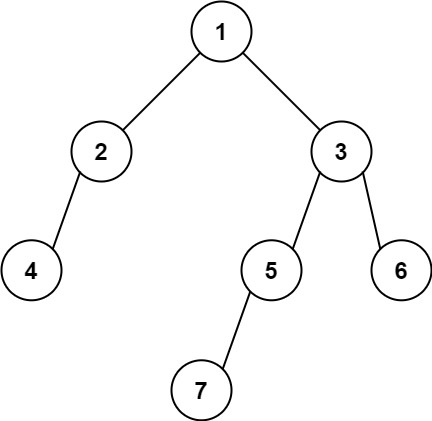
Example 2:

Input: root = [1,2,3,4,null,5,6,null,null,7]
Output: 7


Constraints:

  • The number of nodes in the tree is in the range [1, 104].
  • -231 <= Node.val <= 231 - 1

A:

递归, 找出高度,然后对比看看左子树的是不是这个高度。 

如果是,则只需要看左子树。否则看右子树

/**
* Definition for a binary tree node.
* struct TreeNode {
* int val;
* TreeNode *left;
* TreeNode *right;
* TreeNode() : val(0), left(nullptr), right(nullptr) {}
* TreeNode(int x) : val(x), left(nullptr), right(nullptr) {}
* TreeNode(int x, TreeNode *left, TreeNode *right) : val(x), left(left), right(right) {}
* };
*/
class Solution {
public:
int findBottomLeftValue(TreeNode* root) {
return helper(root, getHeight(root));
}
private:
int helper(TreeNode* root, int height){
if(height == 1)
return root->val;
int leftHeight = getHeight(root->left);
if(leftHeight == height -1){
return helper(root->left, height-1);
}else{
return helper(root->right, height-1);
}
}
int getHeight(TreeNode* root){
if(!root)
return 0;
return 1 + max(getHeight(root->left), getHeight(root->right));
}
};

但是上面的解法time 效率不好

************下面是 迭代解法。 beat 100%***************

class Solution {
public:
int findBottomLeftValue(TreeNode* root) {
vector<TreeNode*> V{root};
int idx = 0;
while(idx < V.size()){
if(V[idx]->right){
V.push_back(V[idx]->right);
}
if(V[idx]->left){
V.push_back(V[idx]->left);
}
idx++;
}
return V.back()->val;
}
};


Tuesday, March 25, 2025

901. Online Stock Span !!!!!!!!!!

 Design an algorithm that collects daily price quotes for some stock and returns the span of that stock's price for the current day.

The span of the stock's price in one day is the maximum number of consecutive days (starting from that day and going backward) for which the stock price was less than or equal to the price of that day.

  • For example, if the prices of the stock in the last four days is [7,2,1,2] and the price of the stock today is 2, then the span of today is 4 because starting from today, the price of the stock was less than or equal 2 for 4 consecutive days.
  • Also, if the prices of the stock in the last four days is [7,34,1,2] and the price of the stock today is 8, then the span of today is 3 because starting from today, the price of the stock was less than or equal 8 for 3 consecutive days.

Implement the StockSpanner class:

  • StockSpanner() Initializes the object of the class.
  • int next(int price) Returns the span of the stock's price given that today's price is price.


Example 1:

Input
["StockSpanner", "next", "next", "next", "next", "next", "next", "next"]
[[], [100], [80], [60], [70], [60], [75], [85]]
Output
[null, 1, 1, 1, 2, 1, 4, 6]

Explanation
StockSpanner stockSpanner = new StockSpanner();
stockSpanner.next(100); // return 1
stockSpanner.next(80);  // return 1
stockSpanner.next(60);  // return 1
stockSpanner.next(70);  // return 2
stockSpanner.next(60);  // return 1
stockSpanner.next(75);  // return 4, because the last 4 prices (including today's price of 75) were less than or equal to today's price.
stockSpanner.next(85);  // return 6


Constraints:

  • 1 <= price <= 105
  • At most 104 calls will be made to next.

A:
不能光靠脑子想。
还是要用手画一下。就想出来了。 
思路是这样的:
按照给出的例子:  画了一下,发现stack🀄️ , 必须保存最大的。  不然来了一个新的值, 不能只和最小的比较

但是,如果来了一个大的,那么它前面的小的,就都没有必要保留了。aka,都可以换成他的位置

然后就一下子想出来了。  

还是要画个草图,各种情况都想一下, 就能决定结构。 最终发现还是比较简单的。  
然而,前后花了我最深2,3个小时,如果再加上由此而浪费的时间,就更是太多了

class StockSpanner {
public:
StockSpanner() {
}
int next(int price) {
int preDay = ++nDays;
// first add to stack. then return
while( ! S.empty() && S.top().first <= price){
preDay = S.top().second;
S.pop();
}
S.push({price, preDay});
return nDays - preDay + 1;
}
private:
stack<pair<int,int>> S; // stack, smaller value on higher position. (smallest on top)
int nDays = 0;
};

/**
* Your StockSpanner object will be instantiated and called as such:
* StockSpanner* obj = new StockSpanner();
* int param_1 = obj->next(price);
*/